Showing posts with label Humor. Show all posts

Tuesday, April 25, 2017

Struggles: An Appreciation


A favorite pastime of many New Yorkers is kvetching and kvelling about daily struggles and comparing them to people around us. Often, the comparison becomes a competition. If you are not familiar with the Yiddish vernacular that is peppered into the conversations of New Yorkers, Jew and Gentile alike, I will teach you the necessary terms.


Kvetch - verb: to complain habitually : gripe
Example: “Rachel is always kvetching about her nephew who won’t get a job and find his own apartment.”


Kvell - verb: to be extraordinarily pleased; especially, to be bursting with pride
Example: “Rachel won’t stop kvelling over her son who was recently accepted to law school, much to the dismay of her knitting club.”


As odd as it may seem to outsiders, these two actions are usually performed in tandem, and sometimes applied to the same topic. There is a subtle art to master in complaining about a thing while also turning it into an object of pride.


Maladies and Ailments


Among friends and casual acquaintances, discussions of physical discomfort are as common as commenting on the weather. New Yorkers delight in sharing war stories about the realities of living. Such conversations can escalate into competitions to see who can claim the worst affliction that was suffered in “silence” while life went on as usual.


As an example, I meet with my good friend M every Thursday, and we reserve at least ten minutes to discuss our current bodily afflictions over a drink. If we can’t fill the time with our own afflictions (which is rare), we will invite the bartender to join the conversation. In doing this, we gain new stories to share in future conversations with others, so if our own ailment isn’t applicable, we can at least borrow from a friend; thus earning credibility by proxy.


There are levels to which conditions are appropriate in a given situation. Below is handy reference that will aid in avoiding a mis-step.


(A) New or Casual Acquaintances and Co-Workers
  • Cold, flu, stomach virus (without gory details), minor injuries, minor genetic/hereditary defects, dental procedures, optical problems, ravages of aging (without gory details), rumors of upcoming pandemics and unusual cures.


(B) Outer-Circle Friends, Extended Family Members and Significant Others of Friends
  • Section A, plus: Gastro-intestinal distress (in limited detail), parasites, minor medical procedures and socially-acceptable mental health problems (i.e. Seasonal Affective Disorder).


(C) Inner Circle (choose wisely!)
  • Sections A and B, plus: Gastro-intestinal distress (in full detail), colonoscopies, sexual dysfunctions and/or other related health concerns, weight struggles, substance abuse, taboo mental health problems (i.e. suicidal/homicidal thoughts), documented allergies, full details of medical procedures, incurable or terminal illness and favorite medications.


There are also certain topics that are never appropriate and best kept to oneself.


(X) Nobody
  • Self-diagnosed allergies or gluten intolerance, veganism or any other voluntary food restrictions, aromatherapy, involuntary weight-loss and humble-bragging (i.e. “I can eat whatever I want and never gain a pound”).


Transit Woes


In a metropolis of five boroughs connected by trains, ferries, bridges and tunnels, getting from one place to another is often a process fraught with strife. Between signal failures, track maintenance, re-routes, unscheduled police investigations and “passenger emergencies,” it is common to experience delays multiple times in a day.


Even though these struggles are universal and common, we never tire of sharing the horror stories. They transform even simple tasks, like going to work or picking up groceries, into epic adventures and heroic tales, the best of which should be retold in three minutes or less (because who has time?). Unlike our suburban counterparts, mundane things like buying milk, stamps and laundry detergent in one outing might require three separate stops and more than one method of travel (i.e. bus to subway to foot).


Rather than feeling deflated by the extra effort required to live our lives, real New Yorkers are energized by the challenge and feel triumphant. This reality of metropolitan life inspires us to kvetch over the conditions of our struggles, and kvell over our resilience and determination. There is also a hidden bonus to the constant unreliability of our transit system, which is the socially-acceptable practice of blaming one’s own tardiness on the Metropolitan Transit Authority, when in reality: you just overslept.


Expenses


Thriving in New York is not cheap. This is evident in the astronomical prices of generic pain relievers at Duane Reade pharmacies throughout the city (who are they kidding?). Everything from french fries to electricity is set to its own inflated value that hovers high above the rest of America (with the exception San Francisco). This lead to the formation for the “Rent is Too Damn High” party founded by folically-memorable Jimmy McMillan in 2005 (Google it, you won’t be sorry). Although nobody likes relinquishing their hard-earned money, we do take delight in talking about it whenever possible. This gives us a chance to practice kvetching and kvelling simultaneously. Below are a few common expenses that are discussed frequently by New Yorkers.


Real Estate
In most places, discussing one’s rent is taboo, but not in New York. It is perfectly acceptable to go to a party and ask the host what they pay for the dwelling in which you are consuming free booze. New York landlords and realtors are a whimsical tribe, imagining that anything with four walls and a toilet above the first floor can be listed as a “loft.” A bathroom sink in the living area accessorized with a hot plate and microwave is imaginatively called a “kitchenette.” A fire escape constitutes “outdoor access.” Contact paper newly adhered to the bottom of a drawer counts as “renovation.” Each of these “amenities” has a price tag, and each of these added living costs give the New York tenant more to discuss in mixed company.


Dining


New York is a city of restaurants. New Yorkers, as a group, tend not to cook very often (see description of kitchenette above), so there is a beautiful marriage of supply and demand that makes a true capitalist smile. Restaurateurs throughout the city have devised ways of arranging very small portions of food on very large plates to make diners feel like they are being served a work of minimalist art, when in reality, they are just paying for “negative space.” Although the substance of the meal may be minimal, the bill is anything but.


Mental Health


Many New Yorkers have therapists. I think the only other American city that rivals New York in the amount of psychiatrists per capita is Los Angeles, for obvious reasons. If I were a smarter man, I would have become a therapist myself since I believe the only appealing reason to listen to someone discuss their feelings is for profit. Luckily, I am too poor to acknowledge my feelings, so I do without the luxury of mental health. If I were one of the many New Yorkers that throws their money into the black hole of the mental health establishment, you bet I’d bring it up every chance I could!


Dating and Romance


As in any other city, many New Yorkers are looking for love. Dating in the Five Boroughs is like going to a Sizzler. There’s an endless buffet, constantly replenished with new fare, but the more you eat, the sicker you become. Common challenges of dating in the city are the following:


Location, Location, Location


It is just as dangerous for someone to live too close as it is for them to live too far away. Although New York is big, it can become a very small town in relation to unwanted contact with an old flame. If you date someone in your neighborhood, you risk running into them too easily if things don’t work out, and it’s a big ordeal to find a new grocery store, dry cleaner, pharmacy, local bar and subway route. On the other hand, if the object of your affection lives on Staten Island and you live in Harlem, traversing the New York Harbor on a boat to see them, regardless of how charming they may be, is too much to ask. My ideal relationship would take place on opposite sides of the park, two days out of the week with the stipulation of keeping separate friends and private bank accounts indefinitely.


Too Many Fish


Due to the abundance of options to choose from, many singles in the city become too choosy (myself included). Knowing that there are more than twenty million people in the New York Metro Area (including places accessible by commuter rail), it is difficult to overlook even small flaws in a potential mate. This makes for a culture of flaky singles with the nagging belief that they can always do better. It is for this reason, among others, that many singles in the city remain single, which is typically a much wiser choice.


Cultural Differences


One of the perks of living in New York is the opportunity to encounter new and exciting cultures. If you date someone from an exotic culture, what seems like a fun novelty in the beginning can quickly devolve into constant arguments over food preferences, media consumption and incompatible world-views. Unrealistic fantasies of meaningful cultural exchanges are usually tempered by the reality that past one’s early twenties, we become set in our ways. Rather than acknowledging that fact, it’s easier to find the other parties’ ways intolerable, and call it a day. These are not always insurmountable challenges, but the success rate of long-term union is not promising.


* * *

Struggles make us who we are. They reveal our inner strengths and weaknesses, they steer us on our path of life, and they ultimately distill the “purest” versions of ourselves from the disjointed mess we begin with. People who don’t struggle enough are insufferable, which I know from experience because I have been to California. Rather than lamenting over our struggles, we should appreciate them, hold them dear to our hearts, perhaps even sit with them sometimes and tell them that they’re pretty. If all else fails, our struggles make good conversation starters, which anyone who spends time with the elderly, knows very well. So take pride in your life’s heart aches, love your past regrets and always remember that without them, you’d have nothing to fall back on when you’ve run out of witty repartée.

Wednesday, August 17, 2016

Feelings: A Linguistic Ailment

I feel, therefore; I am?

Over the last decade or so, an alarming disease has spread across the American language. It has rendered speakers, mostly under the age of forty, incapable of articulating a firm declarative sentence. This affliction can be observed in people of nearly every race, religion and credit rating. The most commonly noticeable symptom of this linguistic ailment is an inordinate use of the phrase “I feel” at the beginning of statements where it does not belong. If one is asked an “Either/Or” question, feelings are irrelevant. For example; if a barista asks if you would like whole milk or skim in your coffee, responding with “I FEEL like I want skim…” is unacceptable. The barista, who is getting paid very little to wake up early and be scalded all morning, has no interest in your feelings. The barista simply wants to complete your order and move on to the next dehumanizing task of the day. They are not paid enough to acknowledge your feelings. Nobody is. This is why therapists charge such steep hourly fees. So what, you may ask, has caused this castration of linguistic fortitude? I have a theory that it correlates with, but is not limited to, the following cultural trends and events:


Self Esteem “Self Esteem" was invented in the 1980’s. Prior to this time, people were not encouraged to think highly of themselves by default. If one does not have an artificially inflated sense of self-worth, one is less likely to share their personal insights with strangers. In previous generations, a person had to actually accomplish something meaningful in order to be asked for their opinion. Now, one gets a medal just for participation - AND the false sense of entitlement that comes with it.


Home Video Cameras In the 1980’s and 90’s, American homes were saturated with a new form of technology that turned every family into the stars of their own poorly produced TV shows, still in re-runs during holidays and family reunions to the present day. The home video camera, which began as an expensive novelty item, quickly turned into a ubiquitous documenter of mundane events that could be replayed ad infinitum, or until an overworked VCR scrambled the tape. Previous technologies that produced choppy silent films which required an empty wall and a bulky projector to consume were no match for the ease and portability of VHS tapes. People became accustomed to watching instant replays of their Christmas mornings, Thanksgiving dinners and high school band concerts almost immediately, thus giving everyone the ability to consume themselves as their own entertainment source.


The Writers Strike of 2007-08 In the fall of 2007, a consortium of TV writers banded together for several months and refused to write sitcoms and crime dramas, citing mistreatment and under-appreciation by their producers. Unfortunately, the TV networks were prepared for this. They had amassed an emergency reserve of “reality” shows to fill in the gaps. The American Public quickly adapted to a steady diet of nouveau riche housewives, teen singing contests and food pornography, all of which promoted the culture of self-indulgence and unfiltered “confessional” sharing. When the strike was resolved in 2008, the writers returned to an industry that now demanded more “reality.” Obviously, their plan had backfired. Post-stirke, instead of writing cheesy dialogue accompanied by canned laugh tracks, they had unintentionally created the Bravo network and the catch-phrase, “I’m not here to make friends.


Weblogs, or as we now call them; “Blogs” In the late 1990’s, when the internet was measured out in minutes on a phone bill, a new form of self-publication was invented called the weblog. In their primitive form, these weblogs existed as strings of plain text written by mole people for other mole people who needed a medium more permanent than email, but less formal than journalism. The rest of the world was unaware of their existence until the early 2000’s when the masses were given access to things like LiveJournal and Myspace, thus inventing a medium for angsty teenagers, disillusioned college students and under-loved adults to “express” themselves immediately without the buffer of an editor. Every emotional trauma could be published online for the world to consume. This eventually gave birth to current (as of 2016) mediums like Twitter, Instagram and a pile of other instant gratification services that have given the public a false impression that their problems are unique and that their thoughts are valuable.

• • •

So how can we combat this unseemly malady that has turned the American public into self-obsessed whiners? How can we persuade cultural figures like Lena Dunham to stop perpetuating the preponderance of hedonistic turns of phrase in the dialogue of premium episodic dramas that we shamefully hate-watch without cessation? How can we find a balance between self-worth and self-indulgence? These are questions to be left to you, dear reader. Next time you have the urge to provide an explanation for something, qualified by the phrase, “I feel,” ask yourself; why? Do you really “feel” like you need skim milk in your coffee, or can you just ask for it like a grown-up without having to resort to that level of personal oversharing that benefits nobody?

Tuesday, March 22, 2016

Why Hayley Mills Ruined Our Lives

Hayley Mills with an apple.


Like many homosexuals over the age of thirty, my childhood was saturated with the films of Hayley Mills. From Pollyanna to the Parent Trap to her role as Miss Bliss on the first season of Saved By the Bell, she seemed to be everywhere. One may recall her girlish charms and jaunty British-ness and draw the conclusion that she was harmless and benign. This was the genius of the Disney company and their diabolical scheme to create a society reliant upon therapists, antidepressants and extravagant theme park vacations.

If you are not familiar with the work of Ms. Mills, let me fill you in. She was Walt Disney’s blonde sweetheart of the 1960’s with a vague English accent that never made sense in most of the American film roles she landed. She was relentlessly cast as an innocent young girl placed in troublesome predicaments that were cleverly resolved in the end with the aid of catchy musical numbers and ill-founded hope. Hayley made being a teenager look like a wholesome and light hearted endeavor. Whether it was discovering a long-lost twin at summer camp, solving mysteries on the beaches of Greece or climbing mountains with explorers in search of a missing relative, she promoted an illusion that anything is possible for those with the right outfits and the belief that “things just work out.”

Let’s examine some of her notable films:

Pollyanna (1960)

Pollyanna is a misguided young girl who suffers from delusional thinking. She is, of course, an Orphan sent to live with an estranged miserly aunt played by Jane Wyman, who built a career on perfect posture and crisp diction. Pollyanna’s dead parents were voluntarily destitute missionaries who taught her to always find the silver lining, which they had to do often since they had no money and Pollyanna never even had a doll to play with (which becomes a central plot point later in the story). A series of very dull things occur that I don’t really remember, but the main takeaway is that the horrible aunt doesn’t like the little girl, and the little girl just wants love and approval and a doll to play with. She does everything she can to please the aunt, but it’s never enough, and instead of choosing to appeal to a new target audience, Pollyanna continues to make every attempt to gain the affection of this woman who really needs to get over herself. Somehow the little girl finally acquires a doll at a church carnival, but due to a clever plot twist, the doll falls out of a window and into a tree. Pollyanna then attempts to rescue the doll and predictably falls out of the tree, becoming a paraplegic in an age before public accessibility standards were in effect. Her positive attitude falters for a brief moment, but it is immediately restored when the people of the town all come to visit her in her wheelchair and the aunt finally decides to give up and be civil.

Moral of the story: if you are persistent enough with people who don’t deserve your respect, you can eventually wear them down and force them to like you.

The Parent Trap (1961)

This is perhaps Ms. Mill’s most famous role. Using the magic of primitive trick photography, one actress is able to play twins named Sharon and Susan who were separated at birth and never made aware of each other’s existence. Through a twist of fate, both girls are shipped off to the same WASPy summer camp for affluent white girls. Self-internalized misogyny runs rampant and the twins become enemies instantly after discovering one another. The girl-on-girl drama escalates, elaborate pranks are performed and eventually the pair is forced to live together in isolation as punishment for causing so many camp disruptions. Rather than having a mud wrestling fight to the death, the two girls acknowledge the obvious fact that they are sisters and form an alliance. They spend the remainder of their time at camp engaging in an elaborate espionage scheme to trade identities and manipulate their divorced parents into getting back together. More drama ensues, the parents finally catch on that they’ve been played, and everyone reunites in time for Ms. Mills to perform an upbeat duet with herself that inspires frivolity and re-kindles a spark between the estranged lovers. A few final complications occur, causing the viewer to doubt the effectiveness of the hair-brained scheme, but in the end, all is made right and the girls’ plan is a success.

Moral of the story: If you prey on the emotional weaknesses of others, it is possible to manipulate everyone around you into denying their own experiences and adopting new patterns of behavior to meet your own selfish needs.

Summer Magic (1963)

Set in the ragtime era, this period comedy must have been pieced together from remnants of other failed ideas as fulfillment of an obligation to feature Hayley in a musical. In this film, Ms. Mills is poor again, and forced to abandon city life, following her widowed mother to begin a new life sequestered in a small town in the country. Burl Ives shows up to sing a few songs while helping the family fix up the run-down (but giant) house they are squatting in. Just as the family is starting to feel comfortable, tragedy strikes again, and they are compelled to take in a recently orphaned cousin with chronic PMS. The two girls dislike each other at first, but then bond over teaching a younger girl how to please a man by appearing to be weak and useless in a musical number called “Femininity.” The newly bonded cousins combine feminine forces to beguile wealthy men at a Halloween party in hopes of exchanging their youth and beauty for the resources hoarded by the aforementioned wealthy men.

Moral of the story: If you perpetuate unrealistic gender biases that promote female objectification, you too can escape a cycle of poverty.

Perhaps the rational conclusions to be drawn from these facts are obvious, but just in case, I will break them down. Hayley Mills acted as an agent of the Disney company to lie to generations of American children, setting up unrealistic expectations that made growing up more tedious. Some have reacted to this betrayal by spending unnecessary hours in therapy talking about their feelings. Some have been driven to drink or abuse prescription mood enhancers. Personally, I decided to become a New Yorker, which has been the healthiest of possible outcomes. If you have been wronged by Ms. Mills as so many others have, know that you are not alone.


Monday, March 21, 2016

Sustenance Abuse

An example of a photo that should not be taken, especially with a flash.

For many New Yorkers, a refrigerator is place to store condiments, leftover takeout, cocktail mixers and unsorted mail. Preparing one’s own meals at home is an activity stigmatized by the micro-kitchens found in most Manhattan apartments. This is not to say that knowledge of how to cook is lost on us, for how can one send a steak back to the chef without being able to provide specific instructions for its fine-tuning? Part of what makes living in New York so great is the unending variety of restaurants and cafes that are used in place of home kitchens to keep us nourished and sustained. New Yorkers have uncovered primal instincts locked deep inside of our ancestral DNA that allow us to forage all about the city, finding hidden food sources in unlikely places. Any seasoned local knows at least five meatball sub shops that are off the grid and no more than two street meat carts that will not induce regret. This knowledge comes over time and sometimes at a price paid in antacids and emergency visits to Starbucks restrooms. One of the downsides to this utopia of culinary delights are the types of people that frequent certain establishments. I enjoy a good meal just as much as anyone, but after several years observing various trends in dining behavior, I have come to the conclusion that there are acceptable and unacceptable ways to enjoy oneself while eating out. Picture Imperfect A well presented plate of food is a delight to the eyes as well as the stomach. Many restaurants in Manhattan, and even some parts of Brooklyn now, have perfected the art of laying out food on a dish in such a way that it almost seems a shame to disturb it. A shame as it may be, food is meant to be eaten, not gazed upon. This realization that life is but a fleeting series of ephemeral moments should not spoil one’s appetite, nor should it be cause for documentation. Very few things, aside from a fussy child or a marriage proposal, ruin the ambiance of a delicious meal as much as flash photography igniting flickers of lightning at inopportune moments all over a dining room. The idea of photographing a meal is something that seems akin to a very sad kind of homemade pornography, for what is the appeal of seeing a perfectly grilled salmon steak on a bed of mediterranean risotto that I did not have the opportunity to experience for myself? It’s like reading a cookbook only for pleasure, which I find to be a rather hollow and ungratifying experience. I’d be very disinclined to meet a person who actively seeks out photos of his or her friends’ weekend meals to fill the sad hours of an uneventful life. The biggest offenders used to be young women from general studies programs at NYU with rhinestone encrusted fingernails, but now the disease has spread to grown men and women who really ought to know better. Now, every restaurant patron may be under the false impression that he or she is the next Ansel Adams of crème brûlée. This behavior is unacceptable and should be stopped. You Are What You Don’t Eat Every few years, a new trend in voluntary food restriction sweeps the movers and shakers of the New York dining elite. One moment, it is the highest fashion to abstain from wheat and the next it is consuming dairy only from cows who are sung to sleep by opera singers in the better regions of Long Island (far enough away from Fire Island not to be kept awake by electronic dance hits and lingering fumes of amyl nitrate). Ultimately these practices come and go, but the communities of wretched people who adopt them stay the same. It is disconcerting to go to a diner only to see a newly printed menu highlighting the vegan mozzarella sticks, paleo health shakes and gluten-free bagels with free-range lox and tofu schmear. No thank you. This is not what New York is all about.  Such crimes against the culinary arts should be confined to Los Angeles where they originated. One does not become noble for choosing to omit a perfectly fine source of nutrition from his or her diet. Abstinence from baked goods never made anyone interesting. New York was built on pastrami on rye and kosher franks. Glorifying yourself by bragging about that which you do not eat is not something to celebrate, it is a topic of conversation to be avoided. The Ball Jar Some fashions in dining can start small, and spread virally, like the subway bed bug infestation of 2010. Unlike bed bugs that cause irritation without being visible, other societal ills can be seen with the naked eye. One trend that I have observed taking hold over the last several years, most likely originated in Brooklyn (and I’d bet money on Williamsburg, specifically). It was a small regional outbreak at first, which escalated rapidly. Now, every “cute” bar and cafe from the Far Rockaways to Chelsea to the Marble Hill serves its beverages in old-timey Ball jars. If you are unfamiliar with Ball jars, they are the glass containers in which rural-American grandmothers store their homemade jams and jellies. They should not be used as serving vessels for $16 cocktails. If one is spending $16 to $18 on a watered down drink with a column of hand-carved ice occupying the majority of its volume, it is insulting to have it served in a container worth 25 cents. Idealistic young people who yearn for “simpler times” they never witnessed (à la the great depression or the glamorous days of war rationing) find it charming to be taken advantage of in this manner. These are the same people who believe that online petitions can affect broad social changes. If I wanted to drink out of re-purposed containers, I could just stay home and drink alone, which would save a great deal of money. It is because of this, that I opt to stay in most evenings and enjoy my own company.

Monday, January 7, 2013

A collection of momentary romances...

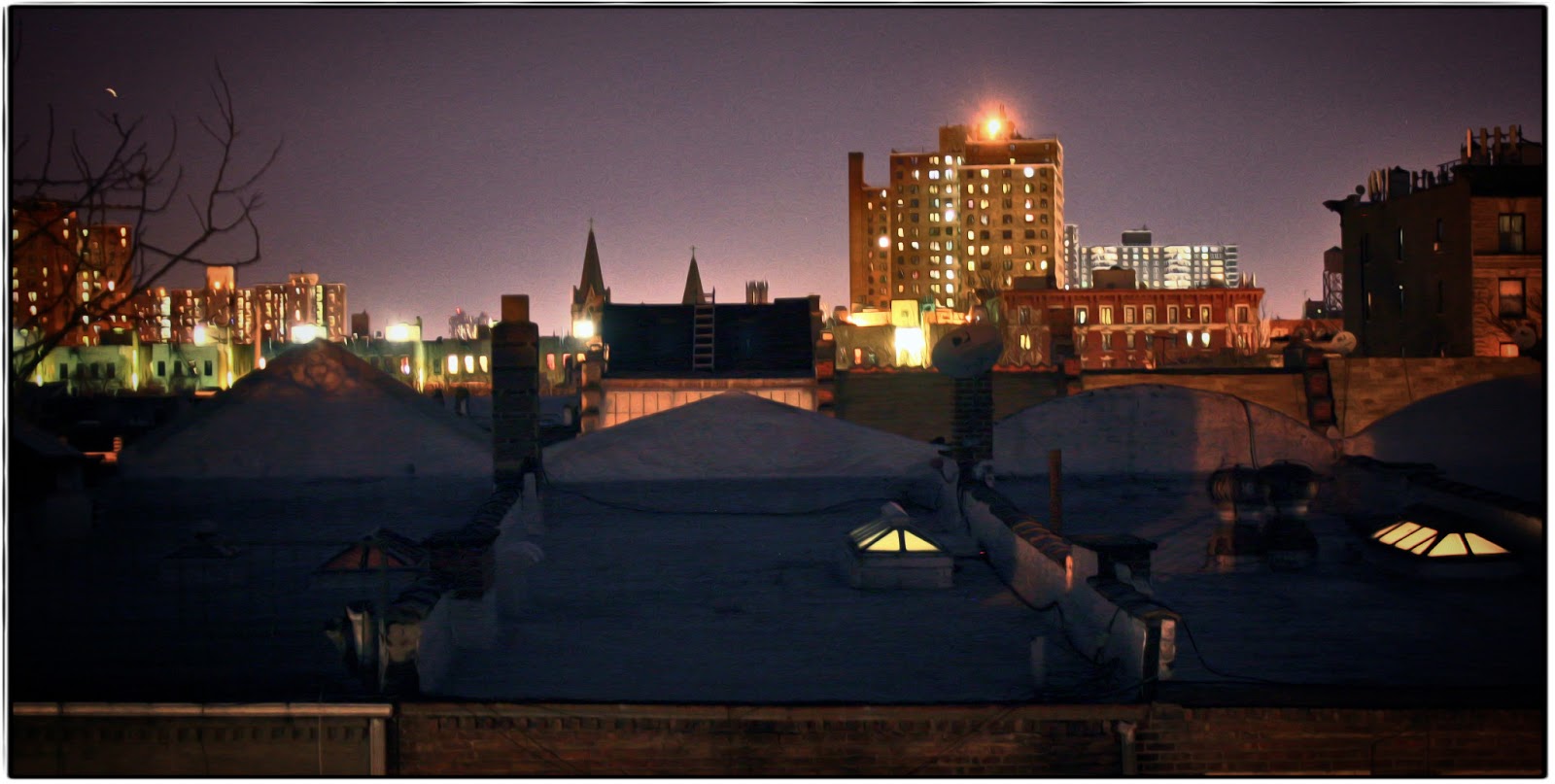
The Harlem sky from my bedroom window.

It is true that I fall in love at least a dozen times a day, sometimes more depending on how many subway rides I might take. Some of these little romances take place for 30, 60, even 90 seconds. Some can last as long as an entire commute if I'm lucky, but they all end in relatively the same way. One moment I'll be sitting (or more often standing and bracing myself against a pole, trying to avoid the sharp elbows and shoulders of others around me) with my nose in a book, and then I'll look up as I turn the page and catch my eye on a person for whom my heart melts like hot butter. Almost as quickly as they appear, they just as easily disappear and then the day continues on...

The violinist:

One evening while changing trains in the labyrinth of tunnels that are tangled beneath the 42nd Street (Times Square) subway station, I took the immense transverse that runs beneath 7th and 8th Avenues. There are times of the day when the maze of tiled passages contain streams of tens of thousands of people all scurrying about rapidly in different directions like ants coming up out of a crack in the earth. There is always the distinct smell of ancient grime, mechanical exhaust and fried food that expands and contracts depending on the weather. Within this vast network of chutes and ladders one can find a wide variety of entertainment from performers to evangelists hoping to make any sort of dent in this ceaseless rumble of footsteps and voices echoing below the city's surface.

At one point there is a very long and steep ramp that runs between the number 7 Train and the A Train. It is lined with mosaics and often with large posters advertising current Broadway shows that can be seen on the streets just above. On this particular evening, I had run out of batteries on my iPod, and as a result, I was unusually more attentive to the sounds around me than I would be otherwise. From the bottom of the great ramp, I could hear something in the distance which was sweet and melodic cutting through the thunder of stampeding humans bounding down the tunnel ahead. It was the faint sound of a violin, singing a sadly beautiful theme. There are often musicians and beggars who frequent this corridor, but rarely do any sound quite as gracefully as what I was vaguely hearing from afar. My pace quickened as I headed forward with curiosity into the great crowd around me. My heartbeat began to hasten as I recognized the tune playing was Chopin's Nocturne. As I drew closer, it echoed through the walls of the tunnel, transforming it into a concert hall rather than a dirty metro station. The tune was being performed with such intimate familiarity that it sounded mournfully sublime. Finally, I was close enough to catch a glimpse of the musician.

He was a smallish man, probably in his mid 30's. He was clean and simple looking. His eyes were closed and his expression was fixed somewhere inside of his mind. He had a black violin case lined with red velvet opened in front of him, and passersby had dropped a few small bills and coins inside. For the most part, he was passed by without a great deal of attention, for after all, a subway station is not a place one generally goes to doddle. Although I had somewhere to go and a train to get to, I stopped for several minutes and listened as he continued to play. If he would have asked me at that moment, I would have surely agreed to marry him, but his eyes never really opened and his awareness of anything but his music didn't seem to falter. Reluctantly, I left after depositing into the velvet-lined case all the change I could find in my pockets (probably amounting to about $1.25). As I turned the corner and the sound of his music faded into the sea of strangers passing by, I made my way to the Uptown A Train with a smile on my face and song that repeated in my head throughout my journey home.

The artist:

There is a section of the A Train that runs express (without stopping) from 59th Street Columbus Circle to 125th Street in Harlem. It is one of the longest singular uninterrupted runs one can take on the New York City Subway. If things are running smoothly, which is often a gamble, from stop to stop it takes about 8 or 9 minutes. This gives one enough time to get involved in some sort of diversion that can make the trip more pleasant, if not interrupted by preachers, political activists, performers or starving mothers begging for change. After a long day of work and running around the city, it's a little treat I often look forward to. I've seen so many peculiar and noteworthy things during this special ride that I could expound for volumes, but at the moment one particular story stands out.

It was one night when I had met a friend for a beer after work at one of those chintzy little Irish pubs that line the streets outside of Penn Station. Was it the Molly Wee Pub, The Blarney Stone or perhaps the Tempest? I'm not quite sure. All I remember is that I had a couple of good stouts in me and I was feeling hopeful about the world. I got on the uptown A Train at 34th Street and by 42nd Street, a group of fashionable young girls got on in my car and took a seat across from me. They all had thick Boston accents, and in their "foreign" dialect, they chattered about nothing of consequence, but the sounds and phrases they used were quite entertaining to me. One of the girls had a particularly flashy pair of boots on, something one would probably find in a mall somewhere in the middle of New Jersey, complete with all sorts of dazzle that made a sure statement of taste. Despite this, and perhaps because of the warm glow I was feeling from the Guinness I had been sipping just moments before, I decided I'd withhold judgment and observe the entertainment before me without expending the unnecessary energy required to mock silently in my own stream of consciousness (or at least I kept it to a bare minimum).

We had passed 59th street, making our way on the long uninterrupted express journey to Harlem, just as one of the girls started talking about something related to Baseball that began to derail my interest. I noticed a hand moving ever so quickly across a page out of the corner of my eye. I discovered a dark thin man in shabby jeans with ink-stained fingers sitting a few seats away from me on the same side of the train car. He had a head full of curly black hair that was pulled back into a little pony tail, revealing a square jaw and a long angular neck. I looked down and saw that he had also made notice of the ridiculous boots of the Bostonian girl in front of us, and he was quickly trying to capture them in a drawing with his pen. He had written some sort of caption above, which I was not close enough to see, but I hoped it said something like "Boston Bedazzled." From what I could see, his line quality and style were reminiscent of Egon Schiele (one of my favorite artists) and for the next 4 minutes I had fallen in love. In my head, Franz Liszt's Liebestraum played, and the rest of the ride was a joy until, inevitably, I had to get off at 125th street and head home to my apartment with visions of the curly haired artist accompanying me along the way. I never saw him again, nor the girls from Boston, but just the same, I'd fallen in love for a good several minutes of my commute which is more than most can hope for in a week.

The Google lackey:

Manhattan decidedly has now joined the world of the tech industry with several large Silicon Valley entities setting up sad little East Coast satellites in old industrial buildings that had seen much better days long ago. It wasn't enough that we in New York had to control publishing, news media, the stock market, the fashion industry, the art world and a number of other trades, but now we've got our fingers in the ever expanding world of the intangible "tech bubble." Situated in Chelsea, in the old Port Authority of New York building, the fortress of Google looks out over the Hudson river, developing new ways to add the woes of New Yorkers to a collection of monetizable analytics. In this relatively new fortress exists an army of awkwardly intelligent minions that can be often recognized without a great deal of effort. They're generally a shade or two more pale than the average person, with insect-like reflexes, a style of dress that reminds one of the folks seen waiting in line at the last Star Wars premiere, and then there's the unmistakable Google lanyard many of them forget to conceal when they leave the building (although I think that some of them purposefully display it as a badge of honor).

One morning, as I stumbled upon the train to work, bleary from an eventful night before, I happened to get squished quite compactly into a very full car. Some insufferable old woman demanded to change seats after the train had already begun moving, which stirred the condensed soup of people into new directions of consolidation. As a general understood rule of train etiquette, once the train begins moving, wherever you have found yourself, you will remain until at least the next stop. The only people who are exempt from this rule are the elderly and Eastern Europeans who just can't seem to get it together on rapid transit. In all the commotion I found myself pushed up against a tall thin man with glasses and a backpack with a water pouch built in. He had the first three signs of Google: the pallid skin, the Lord of the Rings T Shirt and the most definitive - the multicolored and iridescent Google lanyard! My face suddenly found a great smirk growing across it, although I knew not why. I thought to myself, "What about this person makes me chuckle? Sure, he was probably a member of his High School's Audio Visual Club and he probably has a collection of Babylon Five DVD's in his apartment, but how is that so different than me? After all, I was in my school's Lunchtime Library Book Group (which had about 5 members) and I have a whole collection of Woody Allen films in my own apartment that I've memorized forward and backward..."

As I had this little existential debate in my own head regarding which person's brand of nerdiness was more noble, I noticed that Google boy had a pair of very beautiful green eyes behind his glasses. In fact, with less hair gel and perhaps a more neutral T Shirt, Google boy would have been very handsome. Then I looked down and saw that he was reading a biography of Beethoven which made me think of my favorite Beethoven piece, the 2nd movement from Sonata Number 8 (the Pathetique). In realizing that our mutual brands of nerd-dom had found a middle ground, I found Google boy to be quite loveable. For the next two minutes, I debated whether or not backpacks with water reservoirs inside were really so aesthetically bad. As the crowd expanded and contracted at the next stop, he was wrenched from my sight, but throughout the rest of that day, bleary as I may have been, I had a new appreciation for Google.

• • •

There are many other stories I could tell, but these give a small sprinkling of what awaits passengers on the Metropolitan Transit Authority of New York. I'm not sure what the moral of the story may be, or if there really ought to be one, but suffice it to say that the older I become, the less I can control my own ability to fall madly in and out of love within the duration of a train ride. Some of these little experiences offer me insights into myself, others offer me warnings about myself, but mostly they are a good source of entertainment that I couldn't imagine finding anywhere else.

Wednesday, November 16, 2011

Dating and Other Natural Disasters...

A happy couple I saw one evening on the Subway


When I was 19 years old, a young art student with long beautiful locks of hair (golden like the sun, I might add), I received one of the best pieces of advice that I have ever come across. I was casually seeing someone in some undefined artsy bohemian co-mingling of lives who I felt was way out of my league. He was a very well educated, well groomed and well built man who took me out for Tempeh burgers one evening (back in my Vegetarian years) at this little hippie café decorated in macramé just off the university campus, and in my wild naïveté, I was smitten. I couldn't understand why such a dreamy guy would ever have any interest in an awkward, skinny little ne'er-do-well like me, but he did. This was in my younger, more unsophisticated days - before I had blossomed into the wildly saucy and vivacious individual that I have now become, and I was often perplexed that he enjoyed my company as he did. One night, in a lavish moment of brutal self awareness (or perhaps just graceless angst), I asked him what my appeal was to him. I wondered if I was part of some social experiment he was conducting, or if he genuinely found me attractive. I will also point out that he was a bit older than me, and perhaps wiser, and he responded to me saying, "we all have a target audience, and it's just a matter of finding it..."

To look at me, you wouldn't assume I'm a person who gets out very often, much less on dates, but it's just not true. Although throughout my teens and early twenties, I was a perpetual loner aside from a few rare blips on the radar (one blip lasting for two whole years), when I arrived in New York, I found myself in a new world. It could be just the vastness of the population and the unfathomable variety of people from every situation imaginable that have all been crammed together in this one little space, but suddenly my "target audience" seemed to have expanded. Before I knew it, I was going on dates and meeting new people at a pace that I had never before thought was possible (I realized this is what life must be like for pretty people in the normal world outside of the city, only I am neither conventionally pretty nor very normal). For the first time in my life, I was five feet and six inches of "Grade A" eligible dork, and people other than me were noticing. I went through some sort of brief re-adolescence, only this time without curfews or watchful eyes noting my every movement until after about two months I realized what a drag dating actually can be.

After a while, I feel like meeting new people is very similar to going on endless job interviews. You both show up on your best behavior, generally dressed nicer than you would typically care to be, putting on a very one-sided show, selling an image of  yourself that is far from accurate. You both tell bits of a memorized and overly rehearsed monologue highlighting a very brief summary of your general life story, one which you've told before and will probably tell again. Just like a job interview, you can often tell within the first five minutes that the position is really not right for you, and then you spend the rest of your time making polite small talk, forcing a smile of courteous interest and hoping that you'll make it through without breaking character and revealing your true and dismal feelings about the situation as a whole. At least half of the time, one or both of the members of the party feels this way. The worst is when it's not you, and you're actually buying the act the other is putting on.

Although I feel lame for admitting this, I mostly date online. I've never been good at talking to new people at bars or in social gatherings. I believe the last time I was set up on a date by a friend, I seriously contemplated leaning too close to the candle on the table, just so I could "accidentally" catch on fire and have a reason to leave. At least with online dating, you can weed out the folks who list interests like World of Warcraft, Romantic Comedies or the Republican Party on their profiles. You can politely judge them from any number rubrics (I often choose written grammar and photographic lighting to start), and then fill in the gaps of what isn't said with your own imagined version of who this person may be outside of their collection of words, pictures and categorical taxonomies. Even with my very skeptical eye, and my overly cynical imagination, I sometimes make complete misjudgments and realize that I've stepped in something worse than dog mess on the sidewalk. Some folks are really more photogenic than they ought to be, and some must have aspiring fiction novelists writing their online profiles. I try not focus too much attention on appearances, remembering the Sunday School lessons of youth like "Judge not, lest ye be judged" (and I probably "be judged" quite a great deal as it is under that adage), but there is a big difference between saying you're 37 and actually being 50, or showing an image from before you discovered the extra 63 pounds that found their way around your belly. If one has obviously lied about such noticeable things, how can one be trusted about anything important? I'm not actually expecting a response to that question, but I feel there is a difference between leaving out things like your dislike of children or your secret collection of Friends DVD's (both of which I'm guilty of), as opposed to fabricating a completely artificial person who doesn't really exist. I'd much rather be disappointed by "the real you," than a psychotic delusion.

I have been fortunate enough to meet some very dear people and I've even made some great friends as a result of my delayed foray into the world of dating, but ultimately, I go on a lot of first dates that are left at just that. Some people have had potential, and some I genuinely liked, but often the stars just don't align themselves as one's romantic heart would hope. For being such a misanthrope, I am always surprised at my drive to meet new people and see what is out there. I know that I'm no easy pill to swallow - I'm often too harsh, too critical and too eccentric for my own good, but the irrational thought of finding someone to share all of my rantings with who may even show me new things to over-analyze is a pleasant little brain morsel that occupies the realm of demi-thoughts that occur somewhere between sleep and wakefulness. I just need to keep on burning through that "target audience" of mine I know now is out there until I am either satisfied that I've exhausted my supply, or I've finally found what I didn't even know I was looking for to begin with.

Wednesday, September 14, 2011

Summer in the city...

Seventh Avenue in Midtown on a hot July afternoon...

There is a strange sense of joy that is produced by the smells of ripening garbage baking in the sun mixed with taxi exhaust and the aromatic smoke dancing about in the air from food carts along the streets of Manhattan. When the air is heavy with moisture and you can actually see the heat waves bouncing up from the sidewalk, the thought diving headfirst into the pollution of the Hudson River seems like the happiest of retreats from the sun overhead. It begins in late May and lasts through September. Generally by the second week of June all of the stores are sold out of window air conditioner units and herds of dejected looking sweaty wanderers can be seen staring at their empty spaces on the shelves in disbelief and utter devastation. Now that summer in New York City is drawing to a close, I feel my heart sink ever so slightly when thinking about all things I will miss as three seasons must come and go before she returns again. New York is a town that embraces all seasons, but summer above all...

My last summer in the city, or rather I should say my very first, was so frantic that I hardly had time to stop and enjoy it.  Being that I had just moved to New York with no job or prospects, my main goal was survival. Between finding three different bizarre jobs and inventing my "I'm too poor to pay rent AND eat multiple meals a day" diet, the hot summer months quickly melted by as a very strange and colorful blur. When I think back, although it was chaotic and difficult, I can't imagine who I would be now without all of the craziness of that initial adjustment period. This summer, now settled in and a bit more well-nourished, living my glamourous Manhattan lifestyle from paycheck to paycheck, I found myself much more aware of my surroundings and all of the lovely summertime experiences the city has to offer.

One evening in June, I was visiting with a friend in Central Park. He's a very lovely and very peculiar sort of fellow. Partially French and partially Californian, he devotes a great deal of his time to the study of Eastern philosophies and meditations. I think in his "legitimate life" he's some sort of lawyer, but I am horrible with remembering such things. Generally when other people talk about their jobs, I just sort of glaze over and ponder things like, what kinds of dreams might cats have, or what would the world be like if humans were amphibious. By the time someone has finished explaining their profession, I have successfully nodded along while absorbing absolutely nothing. I think that this, by some definitions, may make me a "flake," but I can't be bothered to really care. In any case, I met my friend of unknown profession in a meadowy part of The Ramble while he beat some sort of animal skin drum made specially for him by a member of a Native American tribe with whom he was trying to become affiliated for the purpose of ritual spiritual practices (I think he met up with them sometime before of after Burning Man one year, but I sort of glazed over for that story as well). It was a beautiful evening, and I enjoyed meandering about barefooted in the grass while my friend drummed away in some sort of trance, communing with the "nature" in Central Park. Once I had stepped on one too many cigarette butts in the grass and my companion had finished speaking with the trees, we decided to walk through the park and enjoy the setting sun. We strolled along the winding tree-lined paths of the ramble, up and down the rocky hills until me reached the lake and the Bow Bridge, which then lead us to the Bethesda Fountain and up into the Central Park Mall. Upon passing all of the stoic stone statues of the Poet's Walk under a canopy of stalwart old trees, we began to hear lovely and strange music playing in the distance. As we drew nearer, we could see a large crowd of people moving about in beautiful motions ahead, swaying around like flowers in a breeze. They were all dancing to Argentine Tango music, some dressed in fine clothes and others wearing shorts and t shirts. Under the pink light of the sunset, the swirling mass of people of all ages and colors dancing on that summer evening was a hypnotic scene to behold. It's not often one stumbles upon hundreds of people dancing the tango in public, but it's just one example of the many unexpected happenings that are so easy to come across in New York. It was like viewing a piece of a dream, only the dream was simply one of many realities of the city in summertime.

There are other less pleasant realities of the summertime, such as the amount of tourists crowding the sidewalks and the sight of exposed sweaty cellulite on the subways, but they are all manageable when mixed with the number of outdoor farmers' markets, musical performances, street fairs and bizarre parades from cultures you would  have never known existed. On holidays like the 4th of July, Gay Pride or the Puerto Rican Day Parade, an influx of overly tanned young people with an abundance of hair products find their passages through the bridges and tunnels on the west side of Manhattan from their native New Jersey and they graciously stink up the city with the sounds of elongated vowels and the smells of cheap caffeinated booze. They run about the streets, throwing litter and tragedy along their path, and eventually go back from whence they came, somewhere in suburbia, leaving New York in shambles. In August, Europe comes to the city in droves, enjoying the generous vacation time granted to citizens by their social-democracies and labor practices that would make members of the Tea Party shutter at the thought of the taxes that support such a human-friendly system. Walking about neighborhoods like SoHo and Greenwich Village or the shopping districts of midtown, one can hear a rainbow of languages spoken by strangers in posh sunglasses and sporty shoes (Europeans always have the best shoes for some reason, and it makes me jealous). I always find it curious to see a large group of Italians or Brits completely enthralled by the squirrels in Central Park. Don't they have squirrels in their own countries? Then this line of thinking gets me to wonder if they mentioned that at some point in high school biology class, but I was too busy glazing over and pondering the dream life of cats or the thoughts in the heads of those monkeys they used to send into space before they allowed humans venture that high into the atmosphere...

Now the summer is drawing to a close, and the feeling of change is in the air on the streets. Billboard advertisements for fall sweaters and snappy jackets are popping up everywhere along with window displays in shops incorporating images of colorful trees and smiling porcelain white mannequins in tweed. My second summer in the city has come and gone, but I feel like I embraced it this time around. Now, as the days become shorter and school children with grumpy faces pass me by on my way to the train in the morning, I am beginning to look forward to the crisp mornings to come and the opportunities to wear my favorite cardigans again. I am anxiously awaiting another beautiful autumn in New York, but not without a tiniest bit of mourning for the lovely summer gone by. The summer of 2011 was a very nice one, and I feel very lucky to have spent it in such a wonderful place.


Tuesday, June 28, 2011

My closest and dearest of strangers...

Anonymous portrait, captured somewhere underneath New York City...

I have said, on many occasions, that riding the Subways of New York is a much richer source of entertainment than one would ever find from cable television. Being that I do not have access to cable television, I see the inherent reasons to question my credibility in making such a statement, but I would argue it to the death, regardless. I have recounted stories of humor and woe, mere moments in the lives of others witnessed while moving from one place to another, and I've told narrative tales of things which people are willing only to divulge to strangers in moments of vulnerability, happiness or anger, but the truth of the matter is that the best tales are those untold by the folks who seem to just blend in to the background...

Moving about the city via the Metropolitan Transit Authority is a mess of sensory chaos that closely resembles the lunch room of a junior high school on the day before Spring Break, amplified by one million impatient people trying to get to work on time using a system designed to best-accomodate a significantly smaller population. Getting everyone on the train in the morning is much like trying to squeeze toothpaste back IN to the tube. With so many sights, sounds and smells (yes, smells of every sort) occurring simultaneously, it is a wonder that transit passengers are able to even remember where it is they were going to begin with. Generally when the homeless man is screaming and ranting about his missing foot and all of the people to blame for life's inequalities on one corner of the train, an obnoxious teenager is blaring intentionally-offensive music on a loud speaker at the other, and in between are the haggard and frazzled folks just trying to keep it all together so that they don't murder anyone by the the time they get to work. It is generally in the faces of these people, forcing themselves to disconnect from the massive orgy of events going on around them, that I find something very real and beautiful; perhaps something more human that is expressed when the pressures to engage with others around them are taken away.

A few months ago, I jumped on a certain chic and electronic bandwagon and purchased a mobile device, which needs not be named lest everything in the world eventually become branded, but this unmentioned gadget (for which I have great affinity) has allowed me the pleasure of capturing images relatively quickly, easily and, in many cases, "on the sly." Prior to obtaining this new tool, I would always look about the train on my way from here to there and see the most captivating scenes of the most mundane of life's available moments, and wish for a way to share them. I have found in life, that my inability to easily connect with others has only increased my fascination with watching them from a safe distance and making observations. With as much time as I spend eavesdropping and staring at strangers, one would think I could write an anthropological study, but I've yet to draw any solid or insightful conclusions about my fellow human beings. In my quest for understanding, my prize is generally just additional confusion, however, without a full understanding, there has been at least an acquired appreciation for the aesthetic of the strangers I see around me, just passing the time until they are required to be productive again.

Now, each time I get on the train, I'm looking more intently than ever before, because I've started to document the beautiful nothings I see all around me. I take portraits of people I don't know, people who don't know me either and who are (most often) unaware of my presence. Discretely, I snap silent images of other passengers who strike me during these moments in limbo when we're together. Some are happy and hopeful, others look like the most sorrowful to ever have been thrust about underground, but many are just trying to get through their days with as much pleasantness as life can afford them. In these moments when people are so inwardly focused, it's like seeing them in a state between sleep and wakeful life. For whatever reason, I feel such a strong attraction to these moments and I can't stop my compulsion to capture whatever it is that I find to be so lovely. There is a comfort in being a part of this phenomenon. To be a part of a big swirling soup of the most diverse of human experiences all stewed together inside of a moving train for minutes at a time before the next scene change is something I hope never to take too much for granted.

Although my ethics have been questioned and issues of privacy have been brought forward, I feel like my anonymous portraits of my dearest and closest of strangers on the train have been one of my most effective ways of embracing my city and my love for its citizens. Perhaps I'm deluding myself to think that they're anything more than a mere annoyance brought forth out of sheer boredom, but I feel like my intentions can hopefully be felt in the images produced thus far (be they as low quality as they must, given that I am in no way a real photographer, nor will I ever claim to be). I'm just a friendly subway stalker who steals moments of the lives of strangers. I'm sure one day I'll have grown tired of paying attention to the others around me, but for the time being, I can't help but explore their beauty.


To see more of my subway portraits, click the image below for a public album: